I found this cool surface that is somewhat paradoxical, called the Horn of Gabriel (I know I shouldn’t cite Wikipedia, but the other sites just go on and on). It’s called that because according to Christianity, when the apocalypse happens, Gabe is going to play a giant horn to let everyone know what’s going on.
I start with the graph y=1/x. I then rotate the graph over the x-axis to get a solid. If I only create the graph from x=1 to infinity, then I get a horn shaped surface.
The coolest thing about this horn is a paradox: the horn has a finite volume, but an infinite surface area. The paradox seems to be that I can fill the horn with enough paint, but it will somehow be impossible to paint the side.
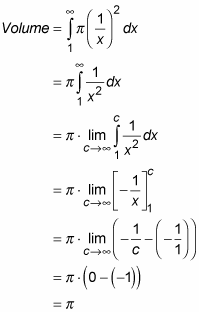
To find the volume, I need to add the volume of every cross-sectional disk from 1 to infinity. The volume of the disk is (pi)r^2 times the change in x. The radius is equal to 1/x for each cross section. This ends up as an integral.
The surface area of each cross section is 2(pi)r times an unimportant radical times dx. The integral for surface area is similar to the integral for volume.
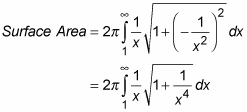
The integral at that point diverges. The integral of 1/x is ln(x). The natural log of infinity is infinity, so Gabriel’s horn has infinite surface area.
So if I have a bucket of paint with pi units, I can completely fill Gabriel’s horn, but I will take forever to paint it. This is theoretically possible; as long as the paint on the horn is infinitely thin, then the paint will never run out, just like how I can draw infinite line segments on a finite circle and never run out of room.
This solution isn’t practical, of course. Paint is not infinitely thin, so the paint will eventually run out when I paint the horn. The horn will also get so small that a paint molecule will not fit in it. This solution is only possible if the paint breaks physics.
Also, naming it a horn does not even make sense. Gabriel will have to stand infinitely far away and somehow hold the horn up, even though it will have infinite inertia. When he blows the horn, his breath isn’t going to make it through because the horn at the end is infinitely small. Even if his breath made it through, it would take infinitely far to make it to Earth. I get that it looks like a horn, but mathematicians should not call it that.
 Weird Math