There is a function that depends on whether a natural number is even or odd. If it’s odd, multiply it by 3 and add 1. If it’s even, divide by 2. For example, if I start with 5, I would multiply it by 3 and add 1 to get 16. Then I would keep dividing by 2 until I get an odd number, which in this case is 1. Computers have tested every number up to the hundreds of quintillions, and every number, when run enough times through the recursive function, eventually yields 1.
The Collatz Conjecture claims that this is true for all numbers. There are no known counterexamples to the conjecture, but there are no proofs either. The only way a positive integer could avoid coming to 1 is if the function will make the integer diverge to infinity. This would require that each value in the function somehow avoids the statistic that, in the long run, every two steps, on average, will multiply the number by 3/4.
This can be proven from an infinite sum. 100% of the time I multiply a random odd number by 3 and add 1, the number will be divisible by 2. 50% of the time, it will be divisible by 4; 25% of the time, it will be divisible by 8…… The likely power of 2 is an infinite sum: 1 + 1/2 + 1/4…… and this converges to 2, and 2 squared is 4. Therefore, every two steps in the function, I will multiply a value by 3/4, on average.
If there is a repeated pattern among odd numbers for what power of 2 the next value will be divisible, then it could be feasible to prove or disprove the conjecture. I created the function that tests the greatest power of 2 that will go into (3x + 1). The table is shown below.
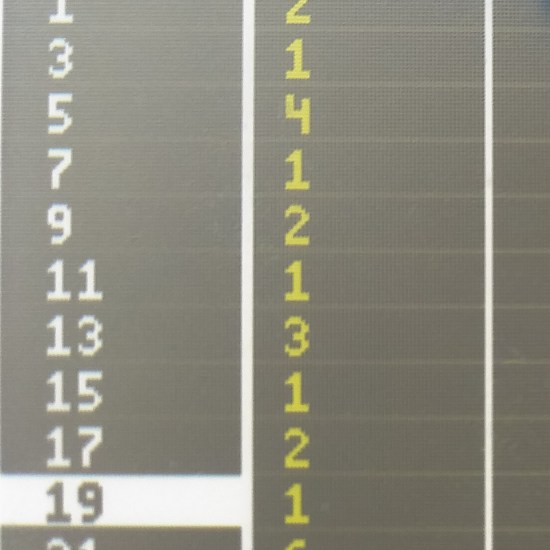
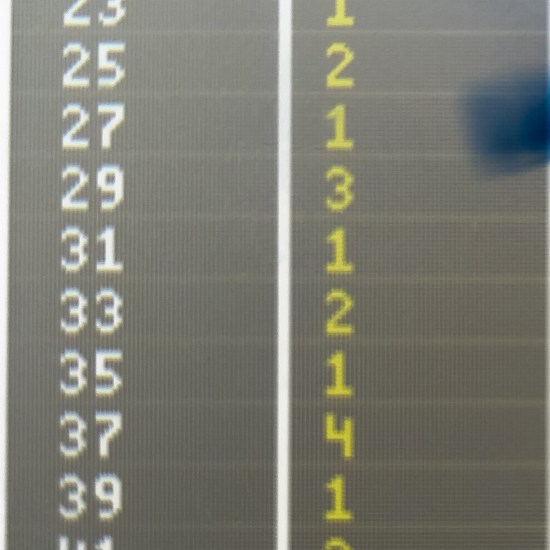
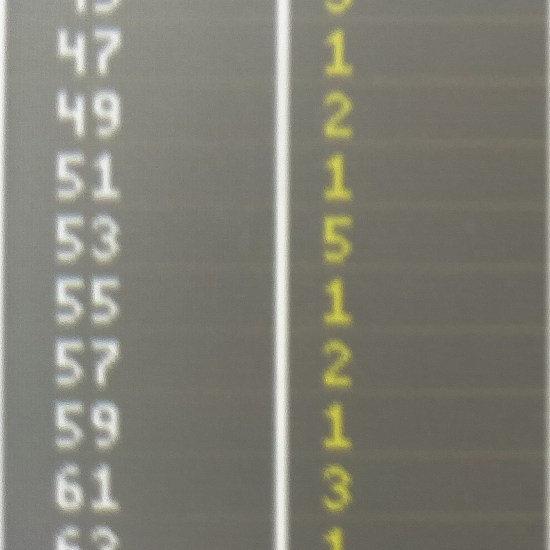
This is a pattern, to be sure, but it’s not repetitive. The predictability in the pattern is simple enough when I start at 1 and go along the list values: if I raise 2 to the power of the output and multiply it by 2, I will have the difference between every value that gives that output. For example, if I raise 2 to the power of 2 and multiply it by 2, I will get 8, and the difference between every consecutive number that gives an output of 2 is 8.
Whenever a space does not coincide with one of the outputs already used, the lowest even value is used, then the lowest odd value. From 1 to 19, the only outputs seen are 1 through 4. The output for 21 cannot be 1 through 4, so the next value is 6. The next new outputs will be 5, 8, 7, 10, 9, and so on.
Those are all the conditions of the pattern, but I have not found any indication this will help solve the Collatz Conjecture.
On the bright side, I have only found one paper that briefly touches on the pattern before moving on, so I will claim this sequence as my own. This pattern will be called the “Morrow sequence”.
 Weird Math