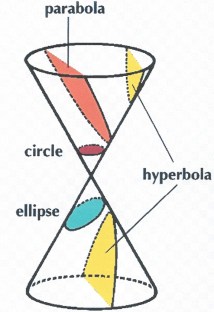
Your math teachers have probably taught you that there are four conics: circles, ellipses, hyperbolas, and parabolas. Each conic looks very different (except circles and ellipses), but the one property that binds these shapes is the fact that they all are found by intersecting a plane and a cone. The type of conic found can be changed by altering the direction of the plane relative to the cone. I could twist the plane any way I wished in three dimensions, and I would only find these four conics.
But what if there are other conics in other dimensions? There’s no reason that we should be confined to mathematics in three dimensions. We only do this because our world happens to have three spatial dimensions. We could see all sorts of new conics by simply looking at the cone from a fourth dimension.
If you’re confused about this, think of a cylinder. If I look at it from the top, I will see a circle. If I view it from the side, an entirely different dimension, I will see a rectangle. I’m doing the same thing to the cone, but from a fourth dimension instead of a third.
If I take an ellipse and look at it from the imaginary axis, I see a hyperbola, and vice versa. If I look at a parabola from the imaginary axis, I get a horizontal line. None of these views gives a new conic. The problem is that I’m only viewing the conics stationed in real axes from imaginary perspectives. To find a new conic, I need to view conics that are not initially stationed in the real x and y plane.
I will start with a regular circle. The equation I need to put in for a circle centered at the origin is:

I am going to make r squared 16 just to make calculations easier. To shift this circle along another dimension, I can substitute (x+i) squared for x squared. I have “i”, the square root of -1, in there because that is how I can shift a shape along the axes. The four axes are the real and imaginary x axes and the real and imaginary y axes. I put in the circle equation at the origin and shifted it along the imaginary x axis so I can view a different conic entirely.
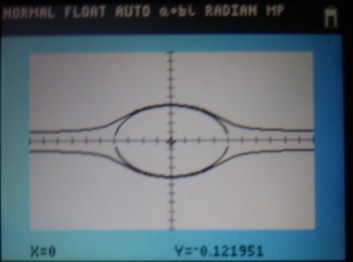
The circle in the middle is not part of the actual shifted curve. I put it there for perspective. The curves that flow around the circle and go on forever are part of the shifted shape.
These curves approach very close to 1 and -1 as they go very far, but they never actually reach there. A line is called an asymptote when a curve trends towards the line in the long run. In this case, the asymptotes are y=1 and y=-1. As I continue to shift the circle along the imaginary x axis and look at it, the horizontal asymptotes get higher, and the bulges in the middle get larger, as shown below.
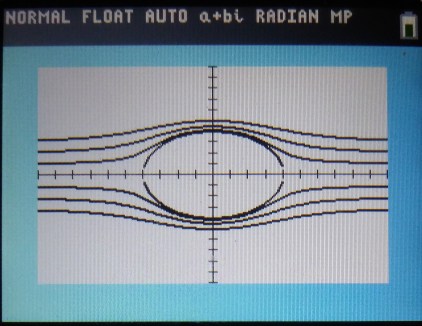
Before you say that this is just a circle in disguise and is not actually another conic, remember, I can view an ellipse from another angle and easily see a hyperbola. This curve has just as much of a separate identity as a hyperbola. I have not found a name for this new curve on the Internet, so I am going to name it after its discoverer. From this day forward, all curves like this will be called “Morrobolas”.
 Weird Math